The Reality of Archival Work Isn't Restoration—It's Chaos
Handling ancient books looks like pure romance from the outside. You imagine white gloves, quiet focus, and the satisfaction of preserving history. The reality is far messier. You are juggling a fragile 18th-century binding that needs immediate conservation, a metadata entry for a manuscript you photographed last week, and an urgent request from a researcher who needs access to a restricted item. These tasks don't live in the same room, let alone the same system. One is physical conservation, one is digital cataloging, one is public service. They all compete for your attention, and the default workflow is just trying not to drop anything. This "scattered priorities" problem is exactly where Taskly finds its footing. It doesn't digitize your collections or repair torn pages. But it transforms how you think about your workload, which is often the more urgent problem.
Why Archival Work is a Brutal Stress Test for Any Planner
Most to-do list apps are designed for a predictable office job. Archival work is the opposite of predictable. You might start the week planning to finish a finding aid. Then you discover mold growth on a quarto volume and the entire week shifts. The trick is that archival tasks are a mix of the deeply long-term (a 200-page cataloging project) and the interrupt-driven (responding to a patron query). Taskly handles this split well because it forces you to break the big things down. I set up a project for a single 1590s manuscript. The main task was "Process Manuscript X." The sub-tasks were brutally specific: "Assess binding condition," "Photograph watermarks," "Transcribe preliminary leaves." Suddenly the massive, paralyzing job of "processing a book" becomes a series of concrete actions. The "joy" in the title isn't a joke—it is the specific relief of knowing exactly what to do next instead of standing in front of a shelf and feeling overwhelmed.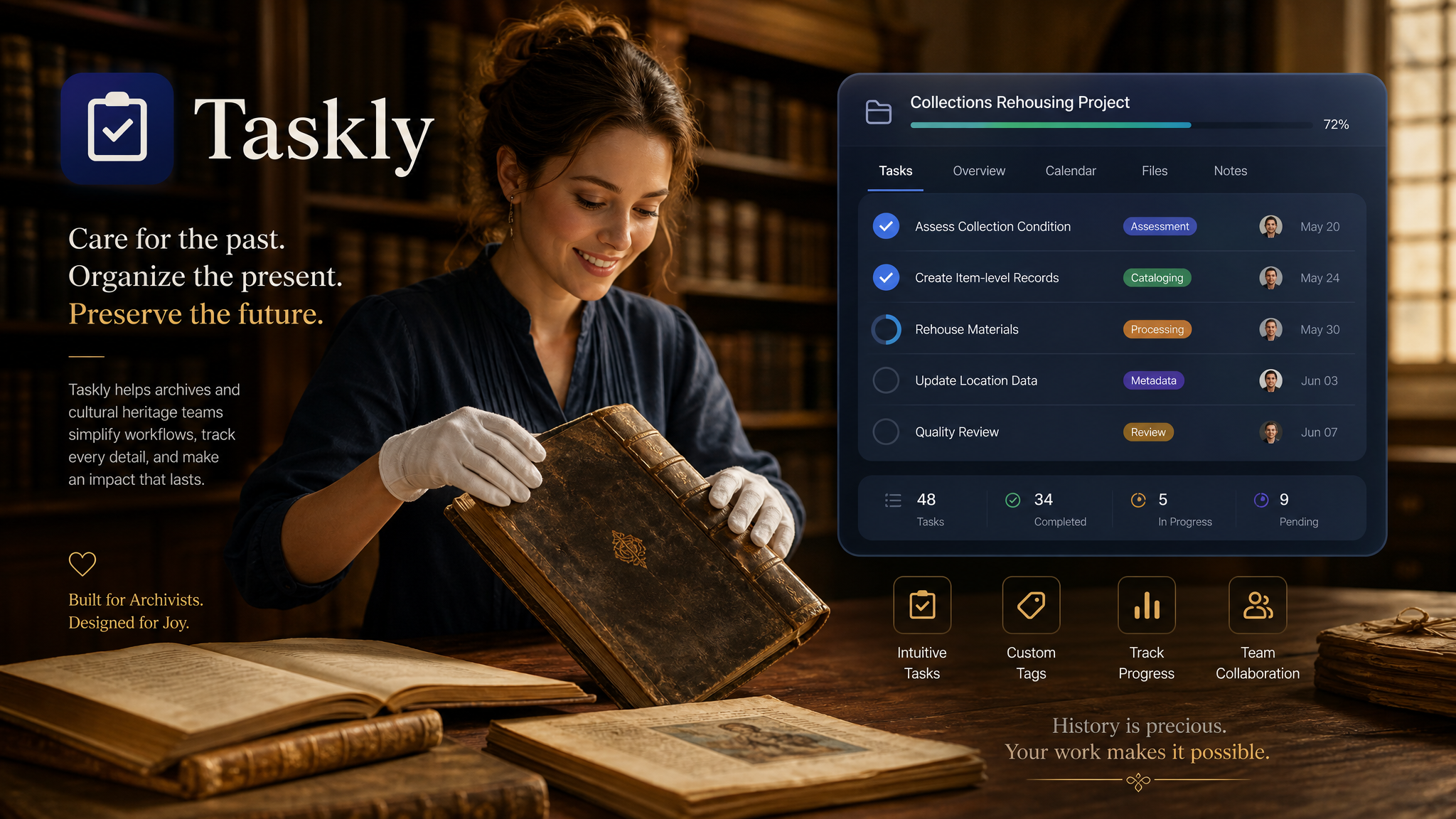
Two Real Workflows Where Taskly Dropped the Friction
First: The Multi-Stage Conservation Loop. An item is rarely handled once. It goes from initial assessment to deacidification to repair to rebinding. Tracking these stages for ten items is manageable. Tracking it for a hundred is impossible without a structure. Taskly's view of weekly tasks let me allocate specific days for specific stages. Monday is "Assessment" day. Wednesday is "Photography" day. The repetition created a rhythm that actually made the work feel predictable, which is rare in this field.
Second: The Research Note Trap. Every archivist accumulates a pile of half-read articles and cryptic notes. I used Taskly to create a recurring "Weekly Reading" checklist, but linked directly to the specific book or collection item. The note function became my external brain. Instead of a stack of sticky notes on my desk, I had a searchable record of thoughts connected to a specific task. It is not revolutionary technology, but it closed a loop that normally stays open for weeks.
The Honest Tradeoff: Generalist Tool vs. Specialist Needs
Here is the fit check. Taskly is excellent at becoming the operating system for your archival workflow. It is not a replacement for specialized tools. You still need ArchivesSpace or a DAM to manage the actual metadata. You still need a conservation database for detailed treatment reports. Taskly sits above those tools. It tells you when to use them. For project leads or freelance archivists managing multiple concurrent projects, this is a huge win. For a processing archivist who only does one linear project at a time in a highly standardized system, Taskly might feel like an extra layer of planning that isn't strictly necessary. The joy comes from the reduction of cognitive load. If your chaos is manageable, you might not need it. If you are drowning in competing priorities, this is a quiet lifeline.
Practical Verdict: It Doesn't Fix the Books, It Fixes the Brain
Does "Handling Ancient Books" become "Pure Joy" with Taskly? The handling itself stays the same. The paper is still brittle. The mold is still dangerous. The metadata is still tedious. What changes is the anxiety surrounding the work. You stop feeling like you are forgetting something. You stop waking up at 3 AM wondering if you logged the condition report correctly. Taskly gives you a single, honest look at your workload. For an archivist, that clarity is the closest thing to joy the administrative side of the job can offer. It is a practical tool for a very specific kind of professional stress. If your messy desk is a pile of scattered priorities, this will clean it up. Just don't expect it to digitize your folios.
Comments
Leave a Comment