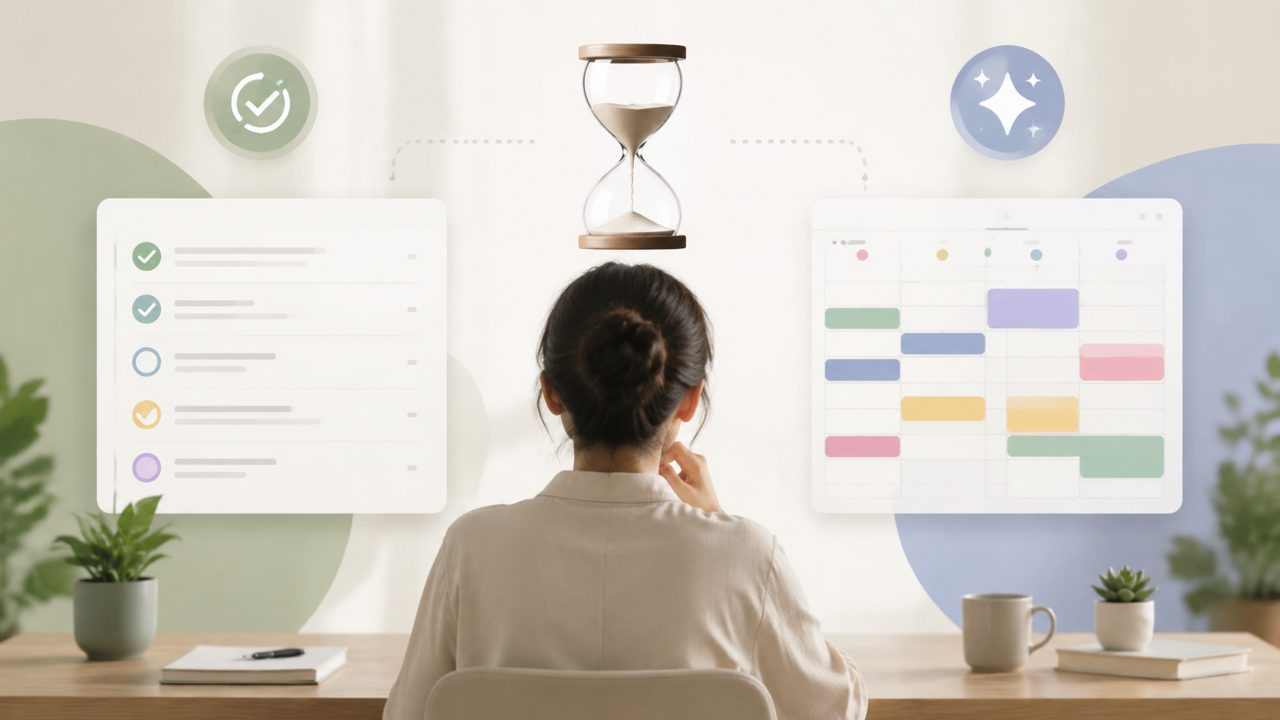
If you're trying to decide between Taskly and Reclaim AI, you've probably noticed they're pitched very differently. One is a straightforward daily planner for tasks and goals. The other is an AI scheduling engine that auto-blocks time for your to-dos. But the real question isn't which one is "better" — it's which one will actually make you more productive without creating new headaches. After testing both for a couple of weeks, I ran into several gotchas that don't show up in the feature lists.
The AI scheduling trap (Reclaim AI)
Reclaim AI tries to solve the "I never have time for my tasks" problem by automatically finding open slots in your calendar. Sounds great, but here’s the first pitfall: it assumes your calendar is the source of truth. If you don't keep your calendar meticulously updated, the AI will schedule over things you haven't entered yet, or it will create repeating time blocks that clash with real-life changes. I had it schedule a "focus block" right over my lunch break three days in a row because I forgot to mark lunch as busy. That's on me, but the AI didn't catch the pattern either.
Another issue: Reclaim AI is best for people with highly structured, meeting-heavy workdays. If your days are more fluid or you have unpredictable interruptions, the constant rescheduling can feel like whack-a-mole. The AI will shift tasks forward, but it doesn't know when your energy dips or when you actually need a break. It's a time-blocking tool with training wheels, not a replacement for human judgment.
Taskly's different kind of friction
Taskly takes the opposite approach. It's not trying to automatically manage your calendar. Instead, it asks you to plan your week manually — picking priorities, breaking down goals, and slotting them into a daily view. The gotcha here is that this requires a consistent habit. During my first week using taskly (the exact product name) for planning, I skipped one evening's weekly review, and the next day the whole system felt useless. It doesn't push you or nudge you if you fall behind. If you're someone who already struggles with maintaining a to-do list, adding a weekly planning ritual on top might feel like more overhead, not less.
But here's the upside: when you do stick with it, the clarity is real. Turning scattered priorities into a clear action plan actually works because you made the choices, not an algorithm. I found that Taskly helped me avoid the "I'll do it later" trap better than Reclaim AI did, because the tasks were consciously chosen for the week, not just dumped into available time slots.
The hype around "best AI task manager"
A lot of people search for "best ai task manager 2026" expecting a one-click solution. Neither of these tools is that. Reclaim AI is often listed among the best free ai task management app 2026 options, but "free" comes with limitations — you get a limited number of tasks and integrations unless you upgrade. I hit the free plan's task cap within two weeks and found the paid tier was more than I wanted to spend just to schedule a few personal errands.
Taskly, on the other hand, doesn't claim to be an "ai smart to do list app" — it's deliberately low-tech. That's a feature for some, a limitation for others. If you're expecting intelligent suggestions or automatic priority sorting, you'll be disappointed. If you just want a clean place to define your goals and check them off, it does that better than most over-engineered alternatives.
A concrete scenario: planning a messy week
I tested both tools for planning a week where I had a mix of deep work, admin tasks, and client calls. With Reclaim AI, I spent too much time adjusting the auto-scheduled blocks to match reality — the AI assumed I could write reports in 30-minute chunks, which wasn't realistic. With Taskly, I sat down for 15 minutes on Sunday evening, listed my three main goals for the week, broke them into daily actions, and added two buffer days for unexpected tasks. The plan wasn't perfect, but it felt mine. I didn't have to fight an algorithm.
The tradeoff became clear: Reclaim AI is better if you have a very predictable schedule and need help finding time for routine tasks. Taskly is better if you want to think strategically about what matters and build a plan around that, but you need the discipline to follow through.
Which one should you try first?
Don't start by asking which is the "best ai task manager 2026." Start by asking yourself: What's actually breaking my workflow? If the problem is that you have tons of free time but keep forgetting to do things, Reclaim AI might help. If the problem is that you're drowning in scattered priorities and need a clearer direction, Taskly is the safer bet — but only if you're willing to invest the planning time.
My cautious advice: try Taskly first for a week. If you find yourself craving more automation and your life is calendar-driven, then test Reclaim AI. But watch out for the hidden costs — both in setup time and in the tendency to trust the AI more than your own judgment. No tool is magic, and the best one is the one you'll actually use without resentment.
Comments
Leave a Comment