Anyone who collects ancient books knows the tension. You want to preserve them, but preservation is not passive. It is a series of recurring actions—checking for humidity damage, noting which volumes need rehousing, scheduling restoration consultations, remembering who borrowed that Ming dynasty woodblock print six months ago.
A spreadsheet can track this. But spreadsheets are cold, and they do not remind you. Taskly, a daily planner built for tasks and goals, turns this scattered worry into a schedule you can actually follow. It is not cataloging software. It is a habit engine for stewardship.
The real problem is memory, not knowledge
Most collectors know exactly what they own. The problem is remembering to do something about it. That rare 18th-century Japanese botanical print needs its washi backing checked every spring. The leather-bound Victorian set needs conditioning every 18 months, not every 24. You know these things. You just forget them in the noise of life.
I started using Taskly specifically to solve this. The key was not dumping my entire collection into one overwhelming list. Instead, I created a project called "Collection Care" and broke it into repeating tasks with realistic intervals.
One concrete example: I own a small set of 19th-century French illustrated journals that are prone to foxing. I set a recurring task in Taskly called "Check journals for new foxing spots" every three months. The task takes five minutes. Without the reminder, I would check them once a year at best, and by then, the spots would have set.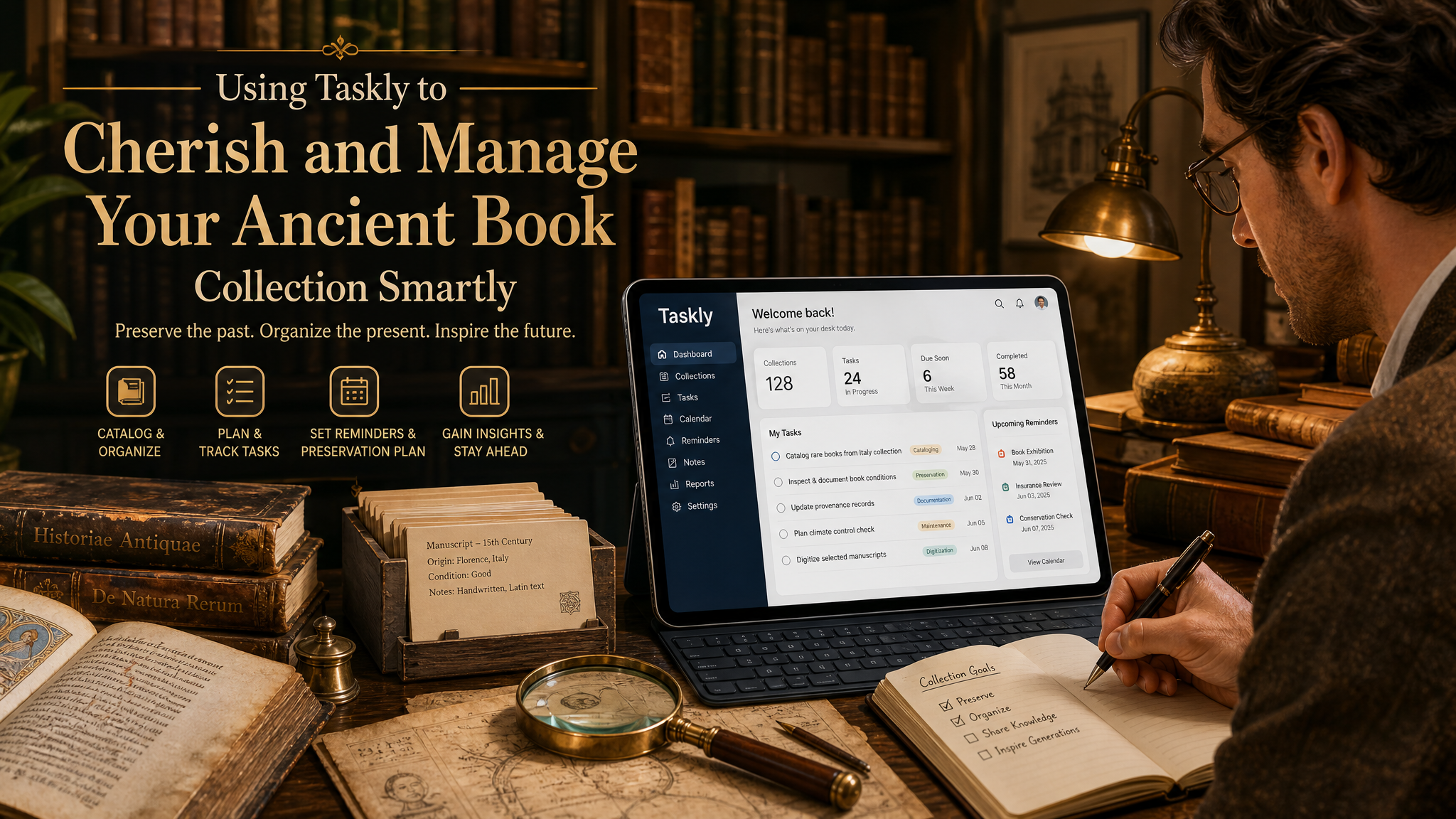
Three scenarios where Taskly changed how I manage my books
1. Restoration appointment tracking
If you send books out for restoration, you know the timeline is unpredictable. The conservator says "about four months." You forget. Six months later, you suddenly wonder where that book is. I now create a task in Taskly the day I drop off a book: "Check restoration status for *Zhu Xi Commentary*" with a due date three weeks before the expected return. The task is tagged #restoration. I review the tag list once a month. No more panicked calls to the conservator.
2. Loan tracking without shame
Lending an ancient book to a friend is nerve-wracking. I used to rely on memory, which meant I either never lent anything out or I lost track completely. Now I do this: whenever I lend a book, I immediately open Taskly and create a task with the borrower's name and the book title. The due date is two weeks before I actually want the book back. The reminder prompts me to send a gentle message. My friends know I use a system. Nobody feels awkward.
3. Environmental habit stacking
Stable humidity is crucial for old paper. I check my dehumidifier water tank daily, but checking the hygrometer reading is something I skip. I added a daily Taskly task timed just after breakfast: "Glance at hygrometer, log number in Notes app." It takes ten seconds. The task forced the habit. Now I have six months of data, and I noticed my library spikes in humidity every August. Without the habit, I would never have seen the pattern.
What Taskly cannot do, and why that matters
Let me be direct about the tradeoff. Taskly is not a catalog. If you need to search your collection by dynasty, by binding style, by restoration history, or by provenance, you need a proper database. I use a separate spreadsheet for metadata. Taskly handles the action layer: what to do, and when.
The risk is that you try to cram everything into tasks and end up with 300 recurring todos. That is not planning. That is noise. My rule is simple: if a task takes more than fifteen minutes or involves complex decisions, it goes on a separate document. Taskly gets only the quick, actionable reminders that I might otherwise skip or forget.
Also, Taskly does not handle location tracking for physical objects. If you store books in multiple rooms or off-site, you still need a system for knowing where each volume lives. I keep that in my spreadsheet. Taskly just asks me: "Did you check the off-site storage this quarter?"
Practical fit: who benefits most from this approach
This method works best if you have between 50 and 500 volumes and you actively handle them. If you own a library of 5,000 books and manage them professionally, you need institutional software. If you own ten cherished books that never leave your shelf, you probably do not need even this much structure.
But if you are in the middle, if your collection is large enough that some books go unchecked for months, and small enough that each one matters to you personally, then using a task planner like Taskly to schedule care is the most practical thing you can do. It turns anxiety into a checklist. It turns guilt into a completed checkbox.
The books do not care about your intentions. They only care about what you actually do. Taskly helps you do it, consistently, without needing to think about it. That is the whole point.
Comments
Leave a Comment